

Tech Talk: Cement Mortar Coating vs. Polyurethane Coating for Steel Pipe
 >
>

What is the difference between cement mortar coating and polyurethane coating in protecting steel pipelines from corrosion?
Cement mortar coating and polyurethane coating protect steel pipelines using two different corrosion protection mechanisms.
Cement Mortar Coating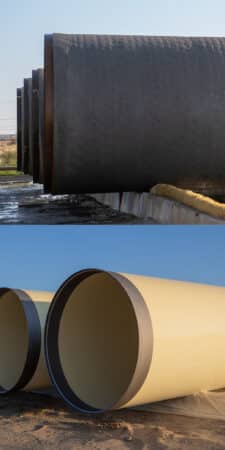
Cement mortar coating works through chemical inhibition. When applied to the exterior of steel pipe in accordance with AWWA C205, the cement mortar creates a highly alkaline environment around the steel cylinder. This alkalinity chemically suppresses corrosion through a process called passivation, dramatically reducing the rate at which corrosion can occur. Reinforcing steel wire embedded in the mortar also contributes structural stiffness to the pipe.
Polyurethane Coating
Polyurethane coating, applied in accordance with AWWA C222, functions as a bonded dielectric barrier. It isolates the steel surface from surrounding soil, moisture, and electrical currents that can accelerate corrosion. The spray-applied polyurethane forms a tough, resilient coating that cures rapidly and provides excellent resistance to abrasion and chemicals.
Both systems provide long-term corrosion protection, but they rely on different protective mechanisms depending on the installation environment.