First Installation of Permalok® Radial Bending Joint Completes Emergency Bypass Tunnel Project in New Jersey
 >
>
1,290 LF Curved Steel Microtunnel Utilizing Permalok® RBJ Installed by Northeast Remsco for the Emergency Pleasure Bay Interceptor Bypass Tunnel
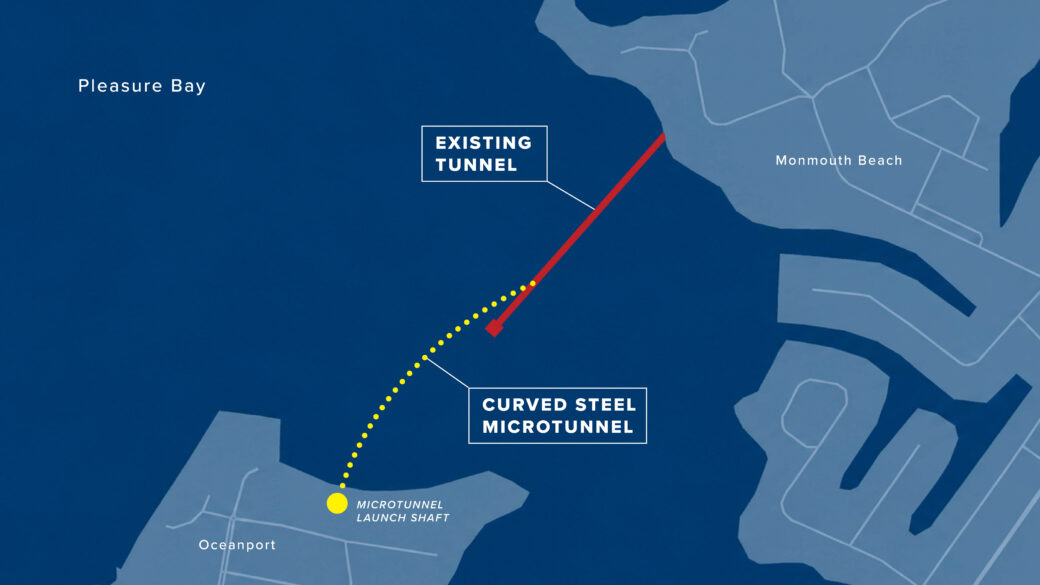
This emergency project for the Two Rivers Water Reclamation Authority (TRWRA) completes the Pleasure Bay Interceptor, originally designed as a 3,250 LF straight-run 96-inch diameter rib and lagging tunnel beneath New Jersey’s Pleasure Bay tributary to the Shrewsbury River. Approximately 70% of the tunnel had been completed when crews encountered tunnel material inflow that interrupted construction within the rib and lagging tunnel. TRWRA and project engineer Hazen and Sawyer developed an alternative approach that allowed the partially completed tunnel to be intercepted by a curved 1,290 LF microtunnel launched from the original tunnel’s exit shaft. The microtunnel was installed by Northeast Remsco using the patent-pending Permalok® RBJ (Radial Bending Joint). This project marks the first-ever use of the RBJ technology, the only steel casing pipe designed specifically for intentionally curved microtunneling alignments.
Pleasure Bay Interceptor History
The Pleasure Bay Interceptor (PBI) conveys sanitary sewer wastewater from Oceanport under the bay to TRWRA’s main pump station located in Monmouth Beach. The existing PBI is a more than 50-year-old reinforced concrete pipeline, and the existing main pump station in Monmouth Beach sustained damage during Hurricane Sandy. Both are nearing the end of their service life. The newly constructed combined tunnel-microtunnel system will include a 54-inch fiberglass-reinforced polymer mortar pipe replacing the aging concrete interceptor.
Emergency Bypass Project Design
When the rib and lagging tunneling operation was interrupted by tunnel material inflow, TRWRA and Hazen and Sawyer evaluated numerous options to safely and effectively complete the project. The selected solution maximized the use of previously constructed infrastructure while providing the most practical and cost-effective path forward. By launching a curved microtunnel from the existing 96-foot-deep Oceanport shaft, crews could intersect the previously completed tunnel at a gentle angle, allowing successful use of both the existing tunnel infrastructure and the previously constructed tunneling exit shaft.
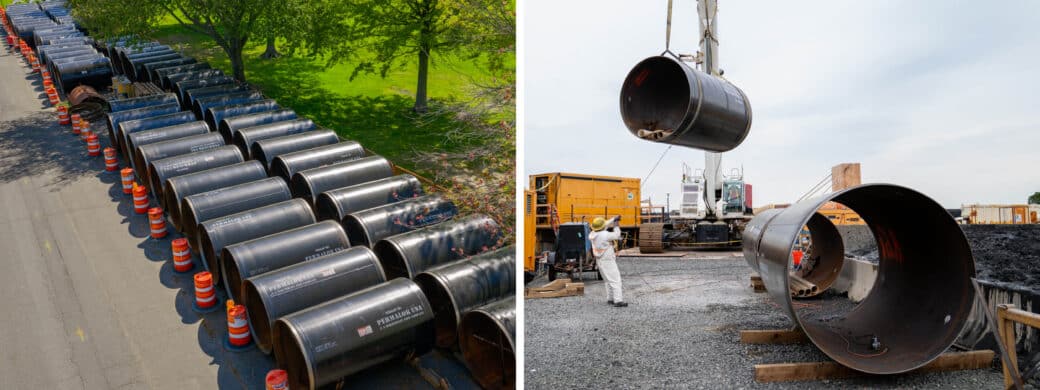
Permalok RBJ was selected as the casing pipe because of its ability to accommodate the approximately 5,500 -foot radius curved alignment. The 72-inch OD pipe was manufactured at Northwest Pipe Company’s Permalok facility in St. Louis, MO, in 10-foot joint lengths with a 1-inch wall thickness.
The shorter joint lengths provided two key advantages on the project. First, they allowed for enough joint articulation along the curved alignment for the specified bend radius to be achieved. Second, they could be handled within the extremely confined 25-foot-ID shaft, which had originally been constructed as a receiving shaft rather than a launch shaft.
Permalok RBJ Installation
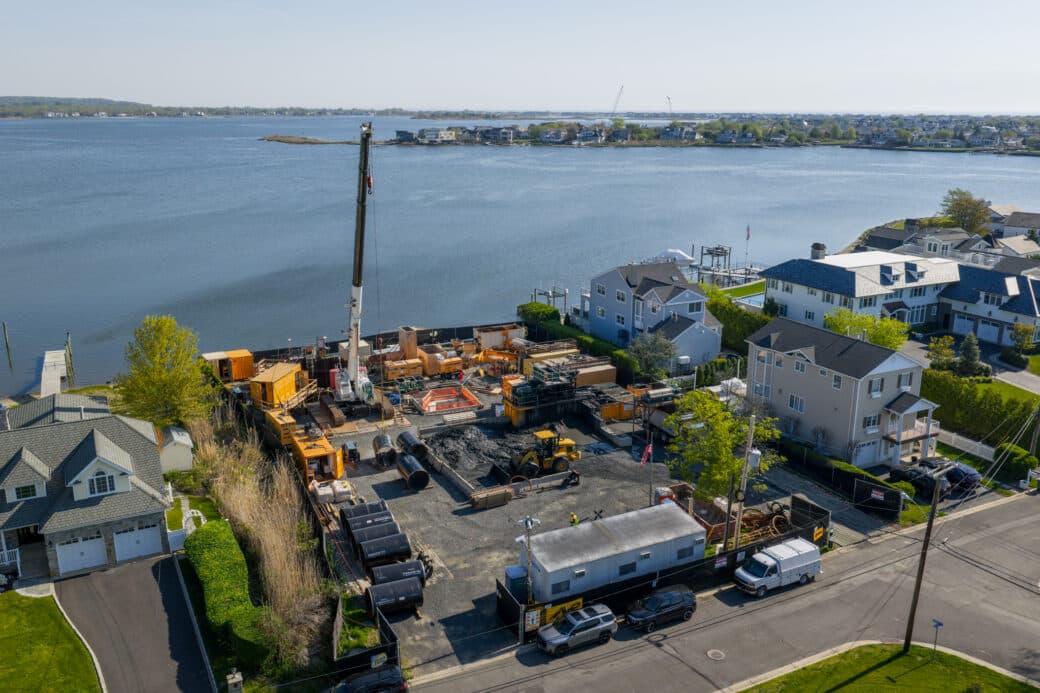
Converting the tunneling receiving shaft into a microtunneling launch shaft required Northeast Remsco to retrofit the structure with a concrete thrust wall capable of resisting the jacking forces generated during installation. Crews also poured a concrete working slab to provide a stable platform for the jacking frame.
Despite the confined shaft and small overall project footprint, Northeast Remsco crews worked efficiently within the restricted workspace. To minimize disruption to nearby residents and maintain an accelerated installation schedule for this emergency project, crews operated around the clock in two shifts with nine crew members per shift during the 72-inch microtunnel installation portion of the project.
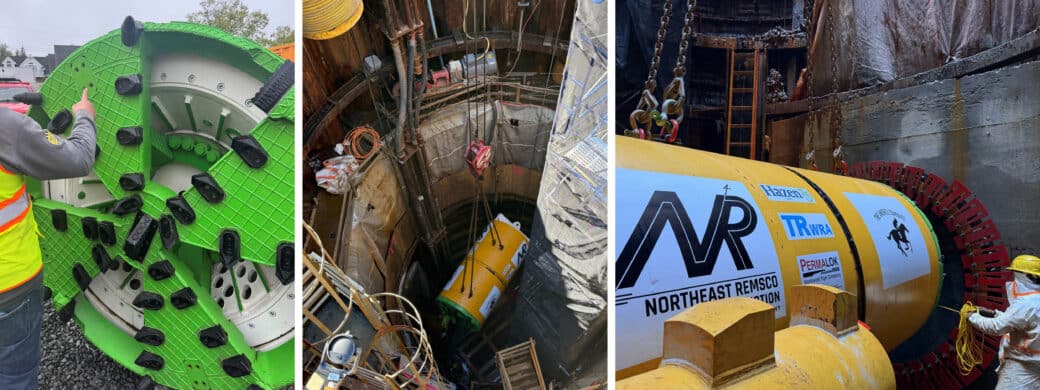
Installation utilized a Herrenknecht AVN 1200 MTBM (microtunnel boring machine) skinned up to 72 inches with a retractable cutterhead, marking the contractor’s first use of this type of machine. The retractable cutterhead was necessary because the microtunnel does not terminate at a receiving shaft. Once the drive is completed, the MTBM must be retracted and removed through the launch shaft. Guidance was maintained using a VMT Total Station remote guidance system, which is the same system Northeast Remsco commonly uses on long straight microtunnel drives.
Permalok RBJ pipe installs in the same way as standard Permalok press-fit joints, with no specialized tools, equipment, or field welding required. The pipe was delivered to the jobsite with internal cross bracing that helps maintain roundness during transport and staging. Onsite, crews removed the cross bracing and added specially fabricated frames designed to support internal tunnel utilities during installation. Each pipe segment was then crane-lifted into the shaft, loaded onto the jacking frame, and aligned behind the previous segment. Utilizing recommended jacking forces, crews then pushed the interlocking joint ends together, efficiently completing the connection without the need for field butt welding.
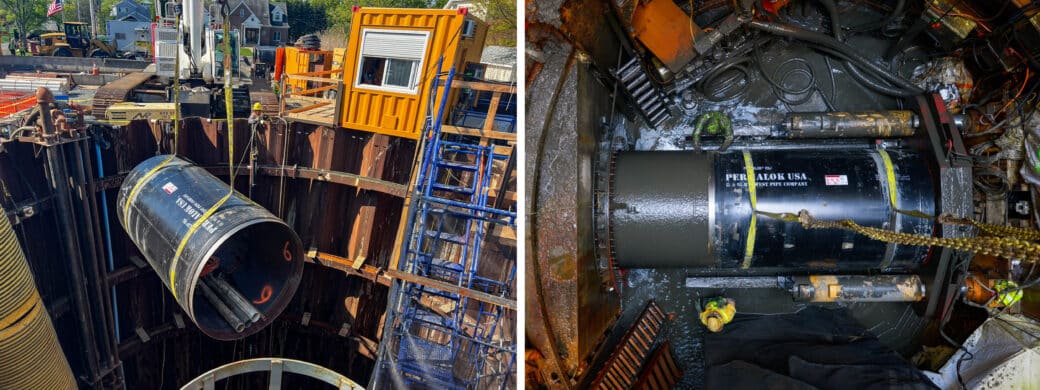
Northeast Remsco crews completed the first several joints in approximately 20 minutes each and steadily increased their connection speed as installation progressed.
To prepare for the tunnel interception, crews cut sections of the steel ribs within the existing rib and lagging tunnel, replacing them with 15 FRP ribs and 14 FRP pipe plank sections, and installed 500 psi grout within the defined tunnel intersection zone volume of approximately 70 feet. This allowed the MTBM to break through the existing tunnel wall once reached. The Permalok RBJ steel casing intersects the existing tunnel, creating a continuous bore path beneath the bay for installation of the carrier pipe.
Joseph Petriello, Vice President of Trenchless Operations for Northeast Remsco Construction, discussed the contractor’s experience using Permalok:
“We’ve been installing Permalok pipe for over 30 years—all diameters and sizes. The RBJ goes together the same way as the T-5 and T-7 joints. There’s a huge time savings using Permalok versus welded steel pipe. A 72-inch field weld would be approximately five hours with two men, and we can make up a Permalok joint in 15 minutes—and that’s the high end.”
Securing Project Success
By combining rapid collaboration, adaptive engineering, and innovative trenchless construction methods, the project team was able to recover from a major tunneling setback and successfully complete a critical wastewater crossing beneath Pleasure Bay. The success of the emergency bypass effort reflects the close coordination between TRWRA, Hazen and Sawyer, Northeast Remsco Construction, and Northwest Pipe Company’s Permalok team, along with a willingness to adopt cutting-edge technology to complete the world’s first-ever curved steel microtunnel using the Radial Bending Joint. The project also demonstrated the future potential of intentionally curved steel casing installations in complex microtunneling applications.